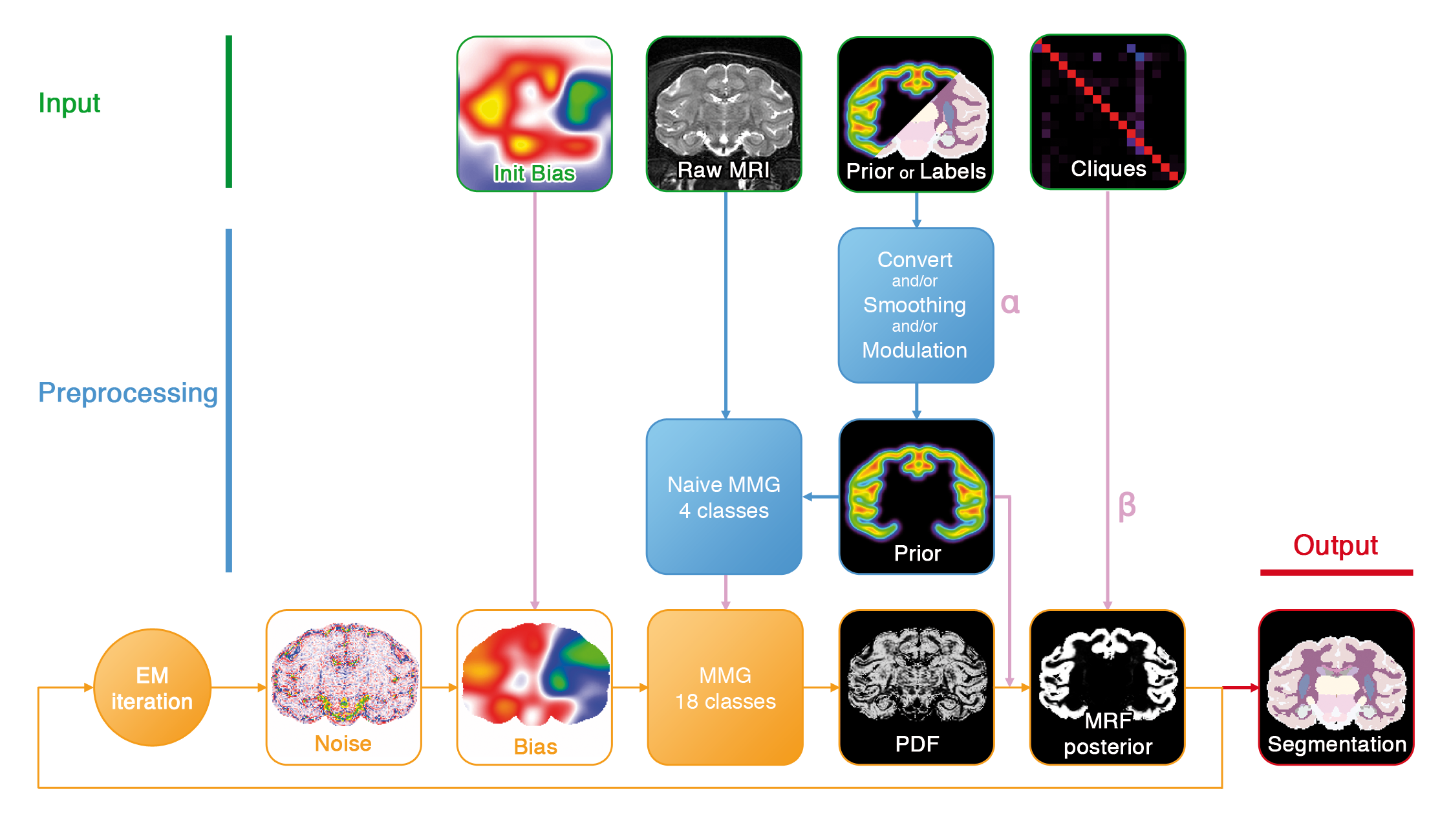
This pipeline performs a bayesian segmentation of MR images, with some parameters optimized by Expectation-Maximization (noise, bias, Gaussian mixture...).
The robustness of the process is increased by initializing mixture parameters from a naive 4-class mixture.
Several preprocessing steps for the non-stationary prior probabilities are possible. If no probabilisitic prior is available, it can be derived from "hard" labels.
EM Segmentation: fits a statistical model to the MRI by expectation-maximization. Intensities are assumed to originate from a gaussian mixture model on a MRF lattice with non-stationary priors. This step also includes densoising and bias field estimation .
Parameters
analysis: String ( optional, input )
Name of the analysis attribute that should be attached to this pipeline output files. If not provided, decision is let to the auto filling system.
Skull-stripping mask. All subsequent analyses will be restricted to voxels inside this mask (parameter estimation, segmentation...). It will also be used to lower the memory load by only loading data inside the mask bounding box.
Labels registered into the input image space. If no truely probabilitic prior is abailable, they can be used to derive prior probabilities by converting them to a 4D image and smoothing it with a Gaussian kernel.
A hierarchy file that classifies each label in one of 5 naive classes (background, CSF, white matter, gray matter, white-gray mixture). It is used to convert the naive 4-class mixture into a full anatomical mixture.
Non-stationary prior used as input for the bayesian segmentation. It can be the unchanged input prior, labels converted to probabilities, or a modulated version of these two possibilities.
 Bayesian Segmentation