 |
anatomist 6.0.18
3D neuroimaging data viewer
|
|
anatomist 6.0.18
3D neuroimaging data viewer
|
#include <anatomist/object/objectmenu.h>
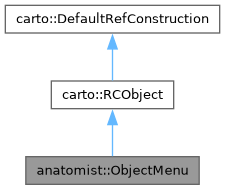
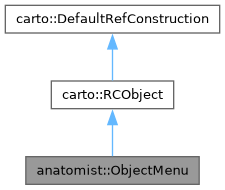
Public Member Functions | |
| ObjectMenu () | |
| ObjectMenu (const ObjectMenu &) | |
| ObjectMenu (Tree &t) | |
| ~ObjectMenu () | |
| ObjectMenu & | operator= (const ObjectMenu &) |
| void | insertItem (const std::vector< std::string > &inside, const std::string &text) |
| inserts a sub-menu | |
| void | insertItem (const std::vector< std::string > &inside, const std::string &text, ObjectMenuCallback *cbk) |
| inserts a terminal menu (with callback). | |
| void | insertItem (const std::vector< std::string > &inside, const std::string &text, ObjectMenuCallbackFunc::CallbackFunc cbk) |
| inserts a terminal menu (with callback as a function) | |
| void | removeItem (const std::vector< std::string > &inside, const std::string &text) |
| Tree * | item (const std::vector< std::string > &pos, bool createSubtrees=true) |
| Tree * | tree () |
| const Tree * | tree () const |
| Tree * | releaseTree () |
| returns the internal tree and release ownership on it | |
 Public Member Functions inherited from carto::RCObject Public Member Functions inherited from carto::RCObject | |
| RCObject () | |
| RCObject (const RCObject &) | |
| RCObject & | operator= (const RCObject &) |
| virtual | ~RCObject () |
Additional Inherited Members | |
| Public Types inherited from carto::RCObject | |
| typedef int | RefCounterType |
| Static Protected Member Functions inherited from carto::DefaultRefConstruction | |
| static const T * | release (const_ref< T > *) |
Definition at line 81 of file objectmenu.h.
| anatomist::ObjectMenu::ObjectMenu | ( | ) |
Referenced by ObjectMenu(), and operator=().
| anatomist::ObjectMenu::ObjectMenu | ( | const ObjectMenu & | ) |
References ObjectMenu().
| anatomist::ObjectMenu::ObjectMenu | ( | Tree & | t | ) |
| anatomist::ObjectMenu::~ObjectMenu | ( | ) |
| void anatomist::ObjectMenu::insertItem | ( | const std::vector< std::string > & | inside, |
| const std::string & | text ) |
inserts a sub-menu
| void anatomist::ObjectMenu::insertItem | ( | const std::vector< std::string > & | inside, |
| const std::string & | text, | ||
| ObjectMenuCallback * | cbk ) |
inserts a terminal menu (with callback).
The ObjectMenu takes ownership of the callback, even if it fails to insert it in the menu tree.
| void anatomist::ObjectMenu::insertItem | ( | const std::vector< std::string > & | inside, |
| const std::string & | text, | ||
| ObjectMenuCallbackFunc::CallbackFunc | cbk ) |
inserts a terminal menu (with callback as a function)
| Tree * anatomist::ObjectMenu::item | ( | const std::vector< std::string > & | pos, |
| bool | createSubtrees = true ) |
| ObjectMenu & anatomist::ObjectMenu::operator= | ( | const ObjectMenu & | ) |
References ObjectMenu().
| Tree * anatomist::ObjectMenu::releaseTree | ( | ) |
returns the internal tree and release ownership on it
| void anatomist::ObjectMenu::removeItem | ( | const std::vector< std::string > & | inside, |
| const std::string & | text ) |
| Tree * anatomist::ObjectMenu::tree | ( | ) |
| const Tree * anatomist::ObjectMenu::tree | ( | ) | const |
 1.13.2